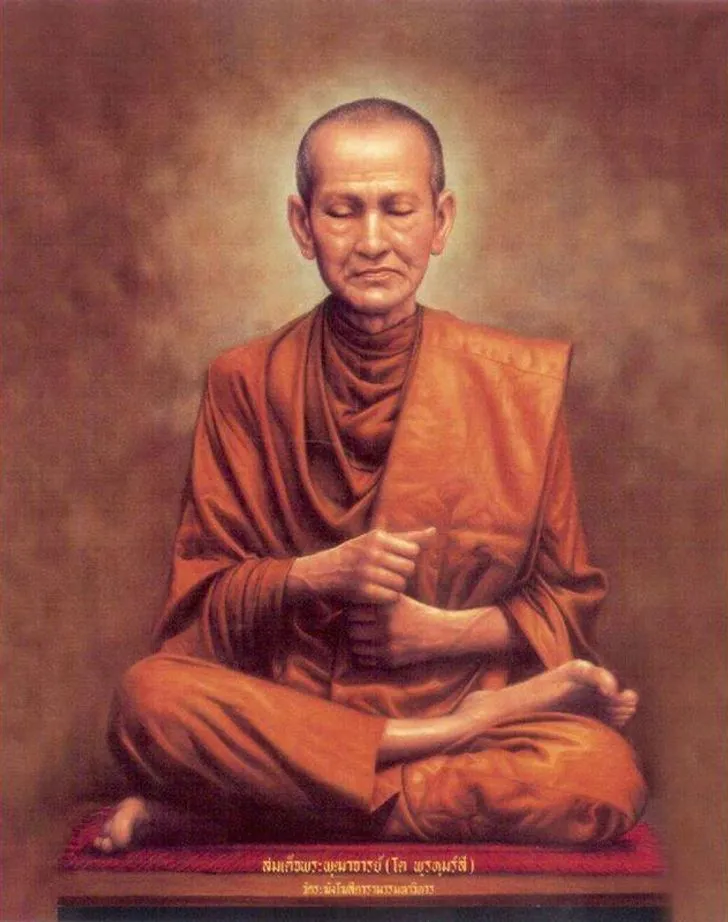
Somdej Toh Phrommarangsi
สมเด็จพระพุฒาจารย์ (โต พฺรหฺมรํสี)
阿贊多(崇迪佛祖)
- Temple
- Wat Rakhang Khositaram
Revered Thai monk (1788–1872), abbot of Wat Rakhang and creator of the Phra Somdej — one of Thailand's five Benjapakee, the most sought-after amulets.
History
Somdej Phra Phutthachan (Toh Phrommarangsi), born simply "Toh" and popularly
known as Somdej Toh, Luang Pu Toh, Luang Phor Toh, or Somdej Wat Rakhang, was
a monk of the Maha Nikaya order and a renowned keji ajahn — a master monk — of
the third through fifth reigns of the Rattanakosin era. He was known as a
senior monk fully endowed with compassion, wisdom, and virtue. Born on
17 April 1788 (B.E. 2331) in Phra Nakhon Si Ayutthaya Province, he entered the
monastic life at a young age and became deeply versed in the monastic
discipline, the Tipitaka, and the Pali language, until in 1864 (B.E. 2407) he
was elevated to the title of Somdej Phra Phutthachan. He held the position of
abbot of Wat Rakhang Khositaram Woramahawihan through the fourth and fifth
reigns, and remained in residence at that temple until his death in 1872
(B.E. 2415).
He is honoured as a master whose conduct and observance inspired deep
reverence, and he was widely revered even during his own lifetime, from the
monarch down to ordinary commoners. Beyond the austerity that so distinguished
him, he was also possessed of extraordinary qualities in the arts of sacred
incantation and in metta mahaniyom, the power to draw affection and goodwill.
The sacred objects known as Phra Somdej, which he created as offerings to the
Buddha, have been placed among the Benjapakee — the five supreme amulets of
Thailand — and single pieces now trade at prices in the millions of baht. For
his observance and these marvellous extraordinary qualities, Thai Buddhists
honour him as one of the immortal masters of Thailand, and he retains a great
many devotees to this day.
Birth
He came into the world during the reign of King Rama I, seven years after the
founding of Rattanakosin, at Ban Kai Chon (Tha Luang), Tha Ruea District, Phra
Nakhon Si Ayutthaya Province, on a Thursday, the twelfth day of the waxing
moon of the fifth lunar month, Year of the Monkey, Chula Sakarat 1150, at the
hour of the alms round — corresponding to 17 April 1788 (B.E. 2331).
Ordination
Having reached a suitable age, he was ordained as a novice in the Buddhist
religion in 1800 (B.E. 2343). It later became apparent that King Rama I held
the novice Toh in very great favour and affection. When he reached the age for
full ordination in 1807 (B.E. 2350), the King graciously granted him
ordination as a royal ordinand (nak luang) at Wat Phra Si Rattana Satsadaram
(the Temple of the Emerald Buddha), with Somdej Phra Ariyawongsayan, the
Supreme Patriarch (Suk Yanasangwon), as his preceptor. He received the
monastic name "Phrommarangsi." Later, King Rama II graciously took the monk
Toh into royal patronage.
Conduct and observance
By the reign of King Rama III, the King wished to confer an ecclesiastical
title in order to honour the monk Toh's repute and merit, but he would not
accept it, having by disposition no regard whatever for rank, title, or
material offerings. Likewise, although the monk Toh had studied the monastic
discipline to the point of thorough mastery, that same disposition led him to
refuse to sit the translation examinations for the scholarly grade of parian.
It is related that the monk Toh afterwards set out on tudong to various
places, raising sacred monuments in each — among them the reclining Buddha at
Wat Satue, Tambon Tha Luang, Tha Ruea District, Phra Nakhon Si Ayutthaya, and
the Buddha image Luang Phor Toh at Wat Chaiyo, Ang Thong Province. Every
sacred monument he built was always of a size befitting his name (Toh means
"large"). Constructing sacred monuments on such a scale necessarily required
vast funds and labour to bring to completion. These works therefore stand as
visible evidence reflecting the faith and the barami of the monk Toh, who was
plainly held in reverence by the Buddhists of the districts through which his
tudong took him.
Ecclesiastical titles
In the reign of King Rama IV, the King held the monk Toh in very high favour,
and so in 1852 (B.E. 2395) conferred an ecclesiastical title on him for the
first time, as a Phra Rachakhana with the title "Phra Thammakiti," together
with the position of abbot of Wat Rakhang Khositaram. He was 65 years old at
the time. The monk Toh had ordinarily avoided receiving such conferrals, but
for certain reasons he was obliged to accept in the end. Two years later
(1854, B.E. 2397) he was raised to senior Phra Rachakhana with the title "Phra
Thepkawi," and when a further ten years had passed (1864, B.E. 2407) the King
graciously elevated him to Somdej Phra Rachakhana of the Suphannabat rank,
with the title "Somdej Phra Phutthachan," the name inscribed on the
suphannabat reading:
"Somdej Phra Phutthachan Anekpricha Wisutthasilachanyasombat Niphatthutakhun
Sirisunthon Phrotcharik Aranyikkhanarisorn Samananikonmahaparinayok
Tripidokkoson Wimonsilakhan, of Wat Rakhang Khositaram Woramahawihan,
Royal Monastery"
This title was the highest rank, and the last, that he received, up until the
day of his death. People in general commonly named him Somdej Toh or Somdej
Wat Rakhang, while those of his own era called him "Khrua Toh."
Final years
Around 1867 (B.E. 2410), Somdej Phra Phutthachan (Toh) took up the presidency
of the construction of the last important sacred object of his life: the
Buddha image Luang Phor Toh (Phra Si Ariya Metrai) at Wat Intharawihan, called
in that period Wat Bang Khun Phrom Nai. The construction was not completed in
time. With the image built up only as far as the navel, Somdej Phra
Phutthachan (Toh) died in the old pavilion of Wat Bang Khun Phrom Nai on a
Saturday, the second day of the waning moon of the eighth lunar month, Year of
the Monkey, corresponding to 22 June 1872 (B.E. 2415), in the reign of King
Chulalongkorn. His age came to 84 years, he had remained in the monkhood for
64 rains retreats, and he had held the abbotship of Wat Rakhang Khositaram for
20 years.
Traditional beliefs
The meaning of venerating Somdej Phra Phutthachan (Toh Phrommarangsi)
Supporting barami and wisdom
Since Somdej Toh was a senior monk known for keen intelligence, a portion of
those who venerate him believe that recollecting him helps support greater
wisdom, sharper thinking, and sounder use of reason.
Protection from danger and harm
There is a belief transmitted down among those who take an interest in amulets
that the "Somdej" amulets connected with him are filled with the Buddha-power
of escape from danger and protection from harm. Those who hold to this belief
therefore believe that venerating him brings protection and safety.
Support in goodwill and popular favour
Some of those who venerate him believe they will be held in affection by
others and receive support in various matters, particularly in their work and
in negotiation and dealings.
Increasing merit and barami through recollecting one who practises well
According to Buddhist tradition, calling to mind a noble monk counts as an act
of very great merit, and helps raise the mind of the person recollecting.
Many of those who venerate him hold this to be the heart of the practice.
Support in fortune and prosperity
Another portion of those who venerate him believe that he helps sustain their
fortunes, brings prosperity, and opens the way for life to run smoothly.
*These five beliefs differ from person to person. Some who venerate him hold
all of them, some place importance on only certain ones, and some venerate him
solely to keep his observance before them as an example. They are not
demonstrable fact.*
No amulets related to this master at the moment