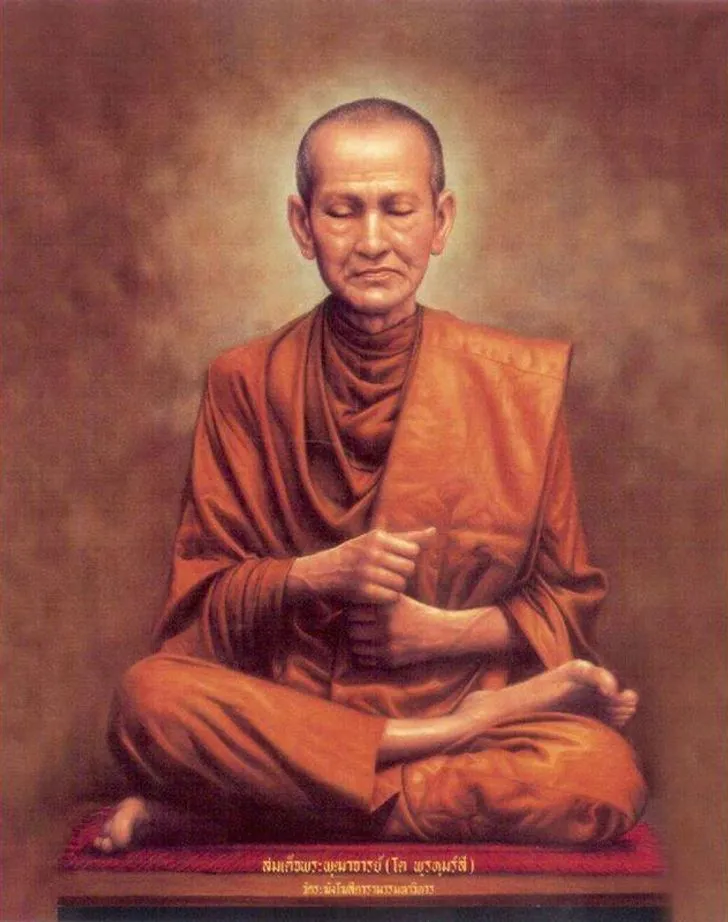
Somdej Toh Phrommarangsi
Revered Thai monk (1788–1872), abbot of Wat Rakhang and creator of the Phra Somdej — one of Thailand's five Benjapakee, the most sought-after amulets.
เขตบางกอกน้อย กรุงเทพมหานคร
วัดระฆังโฆสิตารามวรมหาวิหาร
A royal temple on the Chao Phraya dating to the Ayutthaya era, once Wat Bang Wa Yai. Site of a Tipitaka council under King Taksin, and the temple of Somdej Toh.
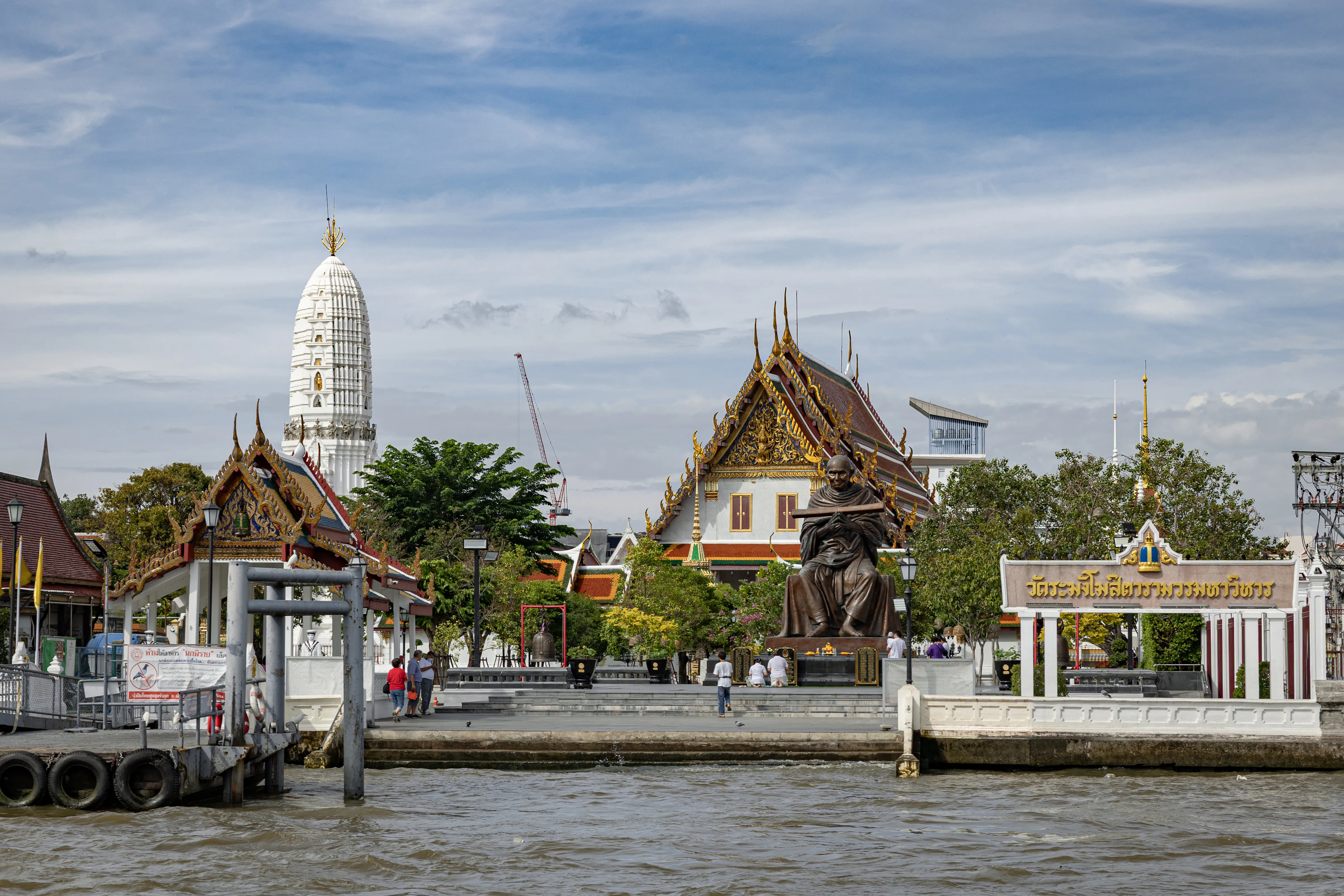
Photo: Mastertongapollo · Wikimedia Commons · CC BY-SA 4.0
Wat Rakhang Khositaram was formerly called Wat Bang Wa Yai. It is an ancient temple dating from the period when Ayutthaya was the capital, and it had a paired temple, Wat Bang Wa Noi, today Wat Amarinthararam.
In B.E. 2312 (1769), King Taksin of Thonburi extended royal patronage and raised Wat Bang Wa Yai from a commoners' temple to a royal monastery. Reflecting that the Tipitaka had been scattered and damaged when the capital fell, the Burmese having burned the towns and the monasteries, he ordered that the Tipitaka be brought from the city of Nakhon Si Thammarat, where it remained complete. On that occasion he met Phra Ajahn Si, a monk thoroughly versed in the Tipitaka and accomplished in insight meditation, who had formerly resided at Wat Phanan Choeng and had withdrawn to Nakhon Si Thammarat when the capital fell. He invited him back to preside over Wat Bang Wa Yai and appointed him Supreme Patriarch. He afterwards had the senior monks assemble at this temple, with Somdej Phra Sangharaja (Si) presiding, to carry out a recension of the Tipitaka, which was brought to full completion at Wat Bang Wa Yai.
When King Rama I ascended the throne in B.E. 2325 (1782), he invited Somdej Phra Sangharaja (Si), who had been stripped of his rank in the reign of King Taksin, to resume charge of Wat Bang Wa Yai as before, and had the monks of this temple and of Wat Photharam (today Wat Phra Chetuphon) take turns receiving alms within the palace, seven days to each temple. Somdej Phra Sangharaja (Si) is therefore counted the first Supreme Patriarch of the Rattanakosin era.
Later, in B.E. 2331 (1788), he ordered a recension of the Tipitaka carried out by a body of 18 monks together with 32 royal scholars at Wat Phra Si Sanphet Daram (today Wat Mahathat), which took five months to complete. It counts as the first recension of the Rattanakosin era, in which the Supreme Patriarch of Wat Bang Wa Yai presided as part of that religious undertaking.
King Rama I recalled the royal residence and audience hall that he himself had had dismantled and re-erected as an offering to the temple, back when he still held the title Phra Rachawarin in the Thonburi period. Wishing to restore them and raise them into a Tipitaka library, he ordered enquiries as to where the sweet-toned bell unearthed at the temple had been found. Learning that it lay to the north-west of the old ordination hall, he had a pond dug on that spot, then had the residence and the audience hall moved and re-erected within the pond as a set of three joined pavilions, together with two large lacquer-and-gilt Tipitaka cabinets installed inside.
The work was placed under the direction of King Rama II, then still styled Somdej Phra Chao Luk Ya Thoe, Chao Fa Krom Luang Itsarasunthon. The lacquer-and-gilt work and the carving in particular are said to be from his own hand, together with master craftsmen from Ayutthaya. When it was finished, the King came in person to perform the merit-making, and planted eight sandalwood trees around the pond, of which only one remains today. The library therefore came to be called Tamnak Chan, the sandalwood residence.
He also asked for that fine-sounding bell to be taken to Wat Phra Si Rattana Satsadaram, and in its place built a four-porched bell tower with five further bells as a royal gift. It was because of the unearthing of that bell that people came to call the temple Wat Rakhang, the temple of the bell, from that time on. It is said that King Rama IV intended to change the name to Wat Khanthikaram, but no one used it, and so it remained Wat Rakhang.
In the early Rattanakosin era this temple stood under the patronage of the princes of the Wang Lang, the Rear Palace. Somdej Chao Fa Ying, Krom Phraya Thep Sudawadi, originally named Sa, the elder sister of King Rama I, had her residence near the temple and so undertook restoration throughout the monastery. King Rama I built one large prang before the old ordination hall as his contribution in support of his elder sister, and ordered the Tamnak Thong, the gilded residence of King Taksin in the old palace, dismantled and re-erected at the temple, dedicated as an offering to the Sangha to serve as the residence of Somdej Phra Sangharaja (Si). Krom Phra Rachawang Bowon Sathan Phimuk, Chao Fa Krom Luang Anurak Thewet, son of Krom Phraya Thep Sudawadi, presented the Tamnak Daeng, the red residence, of which Prince Damrong Rajanubhab and Prince Chao Fa Krom Phraya Narisara Nuwattiwong remarked that it had originally been King Taksin's quarters for meditation practice.
In B.E. 2337 (1794) Somdej Phra Sangharaja (Si) died. After the royal cremation, his relics were placed within an image of Phra Si Ariya and enshrined on the porch of the eastern prang. That image of Phra Si Ariya is enshrined today in the Somdej Phra Sangharaja Si vihara.
As King Rama I lay gravely ill and near death, he gave the command that the umbrella shading his funeral pyre should, once the funeral was over, be presented to the principal Buddha image of Wat Rakhang. When he passed away in B.E. 2352 (1809), the umbrella shading the principal image in the ordination hall of Wat Rakhang Khositaram thus became a nine-tiered white umbrella. It originally shaded the principal image in the old ordination hall, which is today a vihara.
Later, in the reign of King Rama III, a fire broke out among the monks' quarters and spread until the Tamnak Thong too was burned. King Rama III therefore ordered a new ordination hall built and the temple grounds extended to the north, had the cast principal Buddha image enshrined in the new hall, and had the white umbrella brought from the old ordination hall to shade it. Afterwards King Rama VI, Phra Maha Thira Rat Chao, ordered the umbrella's fabric changed to white cloth with gilt openwork, using the old frame; and in B.E. 2504 (1961) King Bhumibol Adulyadej the Great, Rama IX, graciously ordered it renewed after the original pattern once again.
The present principal Buddha image is a bronze image in the meditation posture, with a lap width of a little over four sok, and at its hand are three disciple figures seated with palms joined as though receiving the Buddha's instruction. Where it came from cannot be traced. It is known only from an account that Somdej Phra Phutthakhosachan (M.R. Charoen Isarangkun) heard from an elderly monk of the temple, who said that when he was a child he had seen an image brought in sections by boat, landed at the Tha Ton Sok landing in front of the temple and carried into the ordination hall, from which it was understood that this principal image is cast, and not moulded in stucco.
This principal image is honoured as exceedingly beautiful, so much so that it appears in the words of King Chulalongkorn, Phra Piya Maharaj, on the occasion of his royal visit to present the kathina robes: that going to any other temple is not like coming to Wat Rakhang, for on stepping through the door of the ordination hall, the principal image is smiling in welcome to the sky every time. For this reason he specially conferred upon this principal image the Order of the Nine Gems and the Knight Grand Cordon of the Order of the White Elephant.
At Wat Rakhang Khositaram there is a kathina chanting rite unlike that of any other temple in the kingdom: when the pair of chanting monks come to the natti-dutiya-kamma, they stand and chant from the beginning through to the end, in the manner of the phan yak chant. It is related that in the time of Somdej Phra Sangharaja (Si) as head of the Sangha there, the kathina chant began seated, and the pair of chanters then rose to chant standing partway through. When Somdej Phra Phutthachan (Toh Phrommarangsi) became head of the Sangha there, he asked that they stand and chant from the very beginning through to the end, on the grounds that once one is standing to chant, one may as well remain standing throughout. It has been the custom ever since.